Gangnam Hairline Correction at Mowoolim Clinic: Costs, Recovery & Booking Guide for Foreign Patients
Published by WECIRCLE with its partner medical network. Reviewed under Korean medical advertising rules.
Gangnam Hairline Correction at Mowoolim Clinic: Costs, Recovery & Booking Guide for Foreign Patients
Gangnam hairline correction typically involves an FUE (Follicular Unit Extraction) or DHI (Direct Hair Implantation) procedure to reshape or lower the frontal hairline, and at a Gangnam-area clinic like Mowoolim Clinic, the procedure generally ranges from approximately KRW 3,000,000 to KRW 8,000,000 (roughly USD 2,200–5,800) depending on the number of grafts and the technique used — final pricing is confirmed only after an in-person or virtual consultation and scalp assessment. The procedure itself takes around 3 to 5 hours in a single session. Most patients return to light daily activities within 2 to 3 days, while the transplanted hairline begins to look natural over 6 to 12 months as new hair cycles through the growth phase. Individual results vary based on donor density, scalp condition, and the degree of correction needed.
A common misconception among foreign patients is that hairline correction in Korea is only for men dealing with significant hair loss. In practice, a large proportion of hairline procedures performed in Gangnam clinics are requested by both men and women seeking a more balanced or aesthetically proportionate forehead — not because of medical-grade baldness, but because of a naturally high or uneven hairline. Knowing this distinction matters when you start researching, because the technique, graft count, and recovery will differ considerably from a standard hair-loss transplant.
Who Is This Guide For — and What Does Hairline Correction Actually Mean?
Hairline correction, as performed at clinics in Gangnam, is a hair transplant procedure designed specifically to reposition, fill, or reshape the frontal hairline. It is not the same as a full scalp hair-loss treatment. The goal is surgical precision over a defined zone — usually the front 2 to 4 centimeters of the scalp — rather than overall density restoration.
This guide is written for international visitors and medical tourists considering the procedure in Seoul. It assumes you are in the early planning stage: comparing costs, trying to understand the difference between FUE and DHI, figuring out how many days you need to stay, and looking for a clinic in Gangnam that can communicate in English.
You will find this guide useful if any of the following applies to you:
- Your forehead feels disproportionately large relative to your facial features
- Your hairline is uneven, asymmetric, or has visible temples that concern you
- You have had previous hair-related procedures and want to refine the front hairline
- You are traveling to Seoul specifically for this procedure and need to plan your itinerary around recovery
- You want itemized pricing before committing to a clinic
According to the International Society of Hair Restoration Surgery (ISHRS) 2022 Practice Census, approximately 38% of hair restoration procedures worldwide now involve hairline design or frontal zone work as a primary goal — up from around 24% a decade earlier. The same report noted a significant rise in female patients, who now account for roughly 28% of all hair restoration patients globally. These figures reflect a broader cultural shift toward hairline aesthetics that goes well beyond traditional hair-loss treatment.
FUE vs. DHI for Hairline Correction — Which One Applies to Your Case?
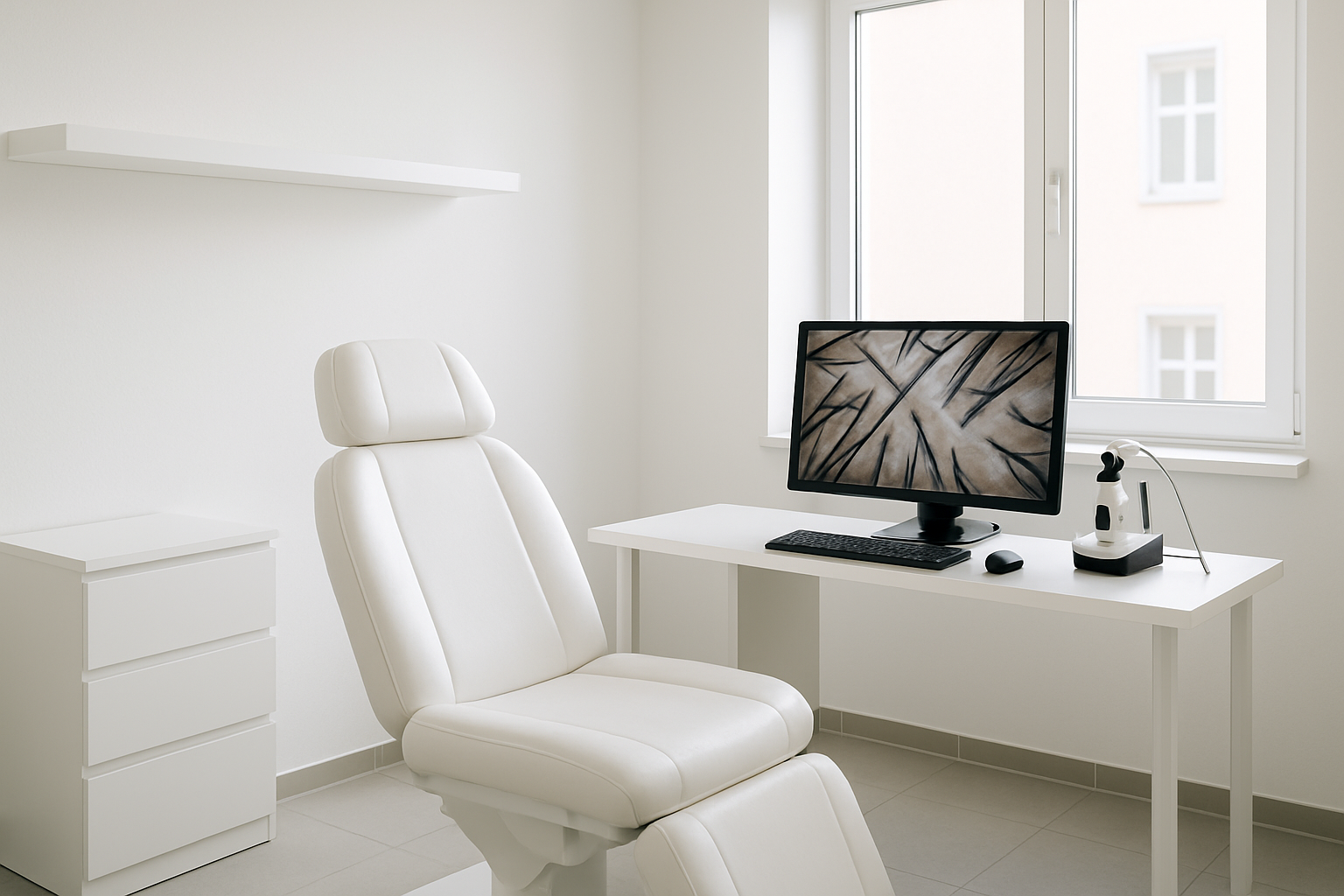
FUE (Follicular Unit Extraction) is the foundational technique: individual hair follicle units are extracted from the donor area (usually the back of the scalp) using a micro-punch tool, then implanted into tiny recipient incisions made along the hairline. DHI (Direct Hair Implantation) is a variation where extracted follicles are loaded into a pen-like implanter device (the most widely referenced device in this category is the Choi Implanter Pen) and placed directly without a separate incision step.
For hairline correction specifically, DHI is often preferred because the implanter gives the surgeon tighter control over the angle, depth, and direction of each follicle — which matters enormously when placing hair along the very front of the scalp where the natural growth angle is subtle and irregular. That said, whether DHI or FUE is right for your case depends on your scalp's donor density and the complexity of the design. A physician consultation with scalp analysis is what determines this, not a general preference.
Here is a practical comparison to help you ask the right questions at consultation:
| Criterion | FUE | DHI |
|---|---|---|
| Incision step | Separate channel creation, then implantation | No separate channel — implanter does both |
| Control over angle/direction | Good | More precise for hairline work |
| Typical graft range for hairline | 500–2,000 grafts | 300–1,500 grafts (higher density zones) |
| Approximate procedure time | 3–6 hours | 4–7 hours |
| Shaving requirement | Donor area shaved | Can be partially unshaved (no-shave DHI) |
| General cost range (KRW) | 3,000,000–7,000,000 | 4,000,000–9,000,000 |
| Recovery to presentable | 5–10 days | 5–10 days |
| Full aesthetic result | 10–14 months | 10–14 months |
One detail that surprises many patients: the graft count for a simple hairline correction is often much lower than for a full transplant — sometimes as few as 400 to 800 grafts if the goal is modest. This is important because pricing in Korean clinics is typically quoted per graft or per session, so a smaller correction can be considerably more affordable than you might expect. Confirming the estimated graft count is one of the most important things to do during consultation — it is also where individual variation makes the biggest difference.
Step-by-Step: What the Entire Process Looks Like — From First Contact to Final Result
Planning a hair procedure from abroad involves more moving parts than a domestic appointment. The steps below reflect the realistic flow for an international patient visiting Mowoolim Clinic in Gangnam.
Step 1 — Pre-Arrival Consultation (1 to 2 weeks before travel) Send photos of your hairline (front, both sides, and top of head in natural light) along with your goals. Most Gangnam clinics that work with foreign patients will review these and give a preliminary graft estimate before you arrive. At Mowoolim Clinic, initial inquiries can be sent via the clinic's website contact form. This is also the stage to confirm English-language support availability and ask for a preliminary written quote.
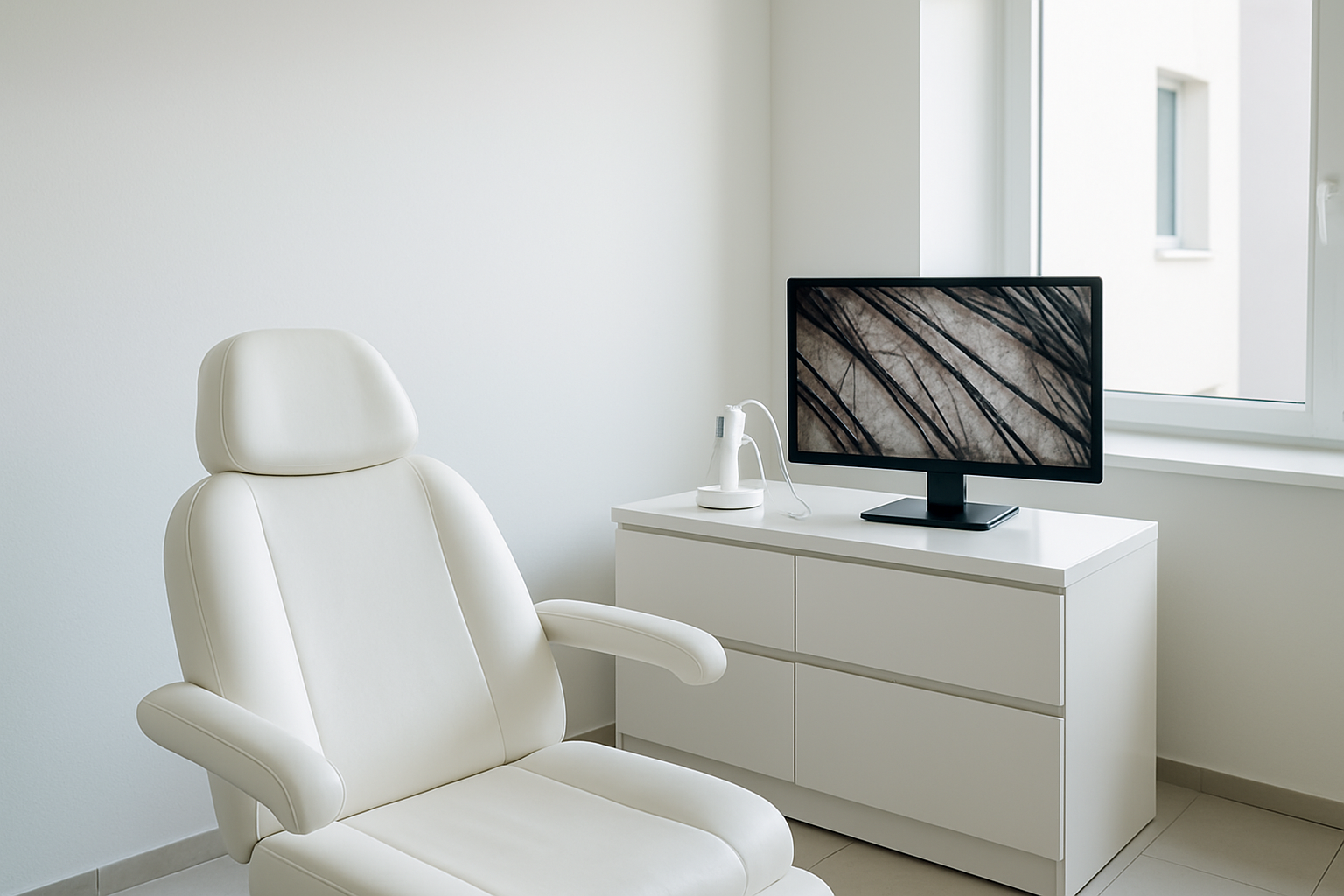
Step 2 — In-Person Scalp Analysis (Day 1 of your Seoul visit) On arrival, a scalp and donor density analysis is performed — typically using a digital dermatoscope or trichoscope to assess follicle health, density per cm², and the donor area's capacity. This analysis directly determines graft count and final price. Plan at least 90 minutes for this appointment.
Step 3 — Procedure Day (usually Day 2 or 3) The procedure takes place under local anesthesia. For a hairline correction of 500 to 1,500 grafts, total chair time is typically 3 to 5 hours. You will be awake throughout. Most patients report manageable discomfort during the anesthesia injection phase; the extraction and implantation themselves are generally not painful. You go home the same day.
Step 4 — Immediate Post-Procedure Care (Days 1–10 after procedure) The scalp needs careful washing from Day 2 or 3 onward using a protocol the clinic provides. Crusting and redness along the hairline is normal during this period. Most patients are comfortable being seen in public within 7 to 10 days, especially with a hat. Avoid direct sun exposure and strenuous exercise for at least 2 weeks.
Step 5 — Shock Loss Phase (Weeks 2–8) This is the phase that surprises patients most. The transplanted hairs will shed — this is normal and expected. It is not a sign that the procedure failed. The follicles remain dormant below the scalp surface during this period.
Step 6 — Regrowth and Maturation (Months 3–14) New hair begins emerging around month 3 to 4. By month 6, you will see meaningful progress. The hairline reaches its full, natural appearance typically between 10 and 14 months post-procedure. Results vary based on individual hair characteristics, scalp condition, and post-procedure care adherence.
Recovery and result timeline at a glance:
| Timeline | What to Expect |
|---|---|
| Day 1–2 | Mild swelling, redness; clinic visit for first wash |
| Day 3–7 | Crusting along hairline; can wear a loose hat in public |
| Day 7–14 | Crusts resolve; redness fades; return to desk work |
| Week 2–8 | Shock shedding — transplanted hairs fall out (normal) |
| Month 3–4 | New hair begins to emerge |
| Month 6 | Around 50–60% of final density visible (typically) |
| Month 10–14 | Full hairline shape and density achieved |
Price Guide — What Does Hairline Correction in Gangnam Actually Cost?
Pricing for hairline correction at Gangnam clinics is not a fixed number — it depends on at least four variables that are only confirmed after your scalp assessment. Here is what drives the cost, broken down clearly.
What determines your final price: • Number of grafts required (typically 400–2,000 for a hairline correction) • Technique selected (FUE vs. DHI; no-shave DHI carries a premium) • Complexity of the hairline design (symmetric reshaping vs. significant lowering) • Anesthesia and facility fees (usually included in bundled pricing at most Seoul clinics)
| Procedure Type | Typical KRW Range | Approximate USD Range |
|---|---|---|
| Hairline correction — FUE, 500–800 grafts | 3,000,000 – 5,000,000 | USD 2,200 – 3,700 |
| Hairline correction — FUE, 800–1,500 grafts | 5,000,000 – 7,000,000 | USD 3,700 – 5,100 |
| Hairline correction — DHI (Choi Implanter), 500–1,200 grafts | 4,500,000 – 8,000,000 | USD 3,300 – 5,800 |
| No-shave DHI hairline correction | 5,500,000 – 9,000,000 | USD 4,000 – 6,600 |
| Post-op care kit and prescribed shampoo | 50,000 – 150,000 | USD 37 – 110 |
Note: The ranges above reflect general market data for Gangnam-area clinics as of 2024–2025 and are provided for planning purposes only. Your actual quoted price will be confirmed in writing after in-person consultation. Foreign patients should also note that Korea's VAT refund scheme (Tax-Free Shopping) does not apply to medical procedures — this is a common misunderstanding worth clarifying before you budget.
From here, the exact number depends on your scalp. Graft count can shift by 20 to 40% once the surgeon assesses your actual donor density and the degree of correction needed. Request a written, itemized quote — broken down by technique and graft count — before committing. Reputable clinics will provide this without pressure.

Mowoolim Clinic, Gangnam — What to Expect When You Visit
Location: Gangnam-gu, Seoul. The clinic is accessible from Gangnam Station (Seoul Metro Line 2) within a short walk. For exact navigation, search Mowoolim Clinic (모우림의원) on Google Maps — the listing address matches the clinic's registered location. You can also visit the clinic's website at http://www.mowoolim.com/ for directions and contact details.
Best for: Patients seeking a focused hairline correction rather than a full scalp treatment, including international visitors who need English-language coordination throughout the process.
Popular procedures: FUE hairline correction, DHI hairline correction using the Choi Implanter Pen technique, no-shave hairline procedures for patients concerned about post-procedure visibility.
Visit flow: 1. Initial inquiry via website contact form — include photos of your hairline 2. Pre-consultation response with preliminary graft estimate 3. In-person scalp analysis and design consultation (Day 1) 4. Procedure scheduled and performed (Day 2 or 3) 5. First post-procedure wash at clinic (Day 2 after procedure) 6. Discharge with written aftercare protocol and follow-up instructions 7. Remote follow-up available for international patients who have returned home
Visitor tip: If you are combining this procedure with a broader Seoul itinerary, schedule your consultation and procedure within the first 2 to 3 days of your stay. This gives you time to recover in Seoul before flying — it is generally advisable to wait at least 5 to 7 days before a long-haul flight after a hair transplant procedure, as cabin pressure and low humidity can affect the scalp during early healing. Confirm this timeline with your surgeon at consultation.
Before your visit, prepare the following:
- Current photos of your hairline: front, left side, right side, overhead — taken in natural light
- Any previous hair procedure records or consultations you have had
- A note of any medications you are taking (blood thinners, finasteride, minoxidil — all relevant)
- Your target date range for the procedure
- A written list of your specific design goals (e.g., "lower by 1 cm," "fill left temple corner")
- Questions about English-language support and whether a written quote is provided
- Your return flight date — the surgeon needs this to plan the procedure timing
How to Choose the Right Clinic for Hairline Correction in Gangnam
There are dozens of hair transplant clinics in Gangnam, and the range in approach, equipment transparency, and communication quality is genuinely wide. The following checklist is designed to help you evaluate any clinic you contact — not just Mowoolim.
Practical checklist for evaluating a Gangnam hairline clinic: • Does the clinic confirm the technique (FUE or DHI) and device name (e.g., Choi Implanter Pen) in writing before you agree? • Is the surgeon performing the extraction and implantation personally, or is part of the procedure delegated to assistants? Ask this directly. • Does the clinic provide a written, itemized quote that breaks down cost by graft count and technique? • Is English communication available throughout — consultation, procedure day, and post-op follow-up? • Does the clinic offer remote follow-up support for patients who have returned to their home country? • Are before/after photos of hairline cases available for review (not general transplant cases, but specifically hairline reshaping)? • Is the post-procedure care protocol provided in writing and in English? • Are there hidden fees — anesthesia, scalp washing, post-op kit — not included in the quoted price?
One factor that is easy to overlook: hairline correction is a design task as much as a surgical one. The symmetry, natural irregularity, and angle of the new hairline depend significantly on the surgeon's aesthetic judgment and experience with frontal zone work. Asking to see hairline-specific case photos — separate from full transplant results — is a reasonable and useful screening question.
A 2021 survey by ISHRS found that among patients who reported dissatisfaction with hair transplant outcomes, the most frequently cited reason (in approximately 42% of cases) was "unnatural hairline appearance" rather than poor survival of grafts. This underscores how much the design stage matters, and why surgeon experience with hairline aesthetics is a relevant factor to evaluate.
How to Book — Inquiry Script and What to Say
When reaching out to Mowoolim Clinic or any Gangnam hair clinic as a foreign patient, a clear and specific first message gets a faster and more useful response than a general inquiry. Below is a ready-to-use inquiry script you can copy and adapt.
English inquiry script (send via website contact form or WhatsApp if available):
"Hello, I am an international patient interested in hairline correction. I am planning to visit Seoul in [month/year] and would like to schedule a consultation at Mowoolim Clinic. I have attached photos of my hairline from the front and both sides. My main goal is [describe: e.g., 'to lower my hairline by approximately 1 cm and fill the temple corners']. I would like to know the estimated graft count for my case, the technique you would recommend (FUE or DHI), a written price quote, and whether English support is available throughout my visit. My planned travel dates are [date range]. Thank you."
Korean version (for clinics requiring Korean-language contact):
"안녕하세요. 저는 외국에서 방문 예정인 환자입니다. 헤어라인 교정을 위해 [월/년도]에 서울 방문을 계획 중입니다. 정면 및 양측 헤어라인 사진을 첨부하였으며, 주요 목표는 [예: '헤어라인을 약 1cm 낮추고 양쪽 템플 부분을 채우는 것']입니다. 예상 이식 모수, 권장 시술법(FUE 또는 DHI), 서면 견적서, 그리고 영어 지원 가능 여부를 확인하고 싶습니다. 방문 예정일은 [날짜 범위]입니다. 감사합니다."
For English-speaking patients, WhatsApp is the most practical channel for real-time communication with Korean clinics that support international patients. When you contact the clinic, confirm the preferred messaging channel for follow-up questions and post-procedure remote check-ins.
Ask for a specialist consultation first and request a written quote before making any travel commitments.
FAQ — Questions Foreign Patients Actually Ask About Hairline Correction in Gangnam
Q1: Is hairline correction in Korea worth it for foreigners? For many international patients, yes — Korean clinics in Gangnam have accumulated significant experience with both FUE and DHI techniques, and procedure costs are generally lower than equivalent services in the US, UK, or Australia when comparing comparable graft counts and surgeon involvement. That said, "worth it" depends on your specific correction goal, your travel budget, and whether the clinic you choose offers adequate follow-up support once you return home. Individual results vary, and no outcome can be guaranteed.
Q2: How much did people actually pay for hairline correction in Gangnam? Based on general market data from 2024–2025, most patients undergoing a focused hairline correction (500 to 1,500 grafts) at Gangnam clinics report paying between KRW 3,500,000 and KRW 7,500,000 (approximately USD 2,600 to 5,500). Procedures involving no-shave DHI or more complex designs tend to fall at the higher end. These figures are ranges, not guarantees — your price depends on your scalp assessment results.
Q3: Can I do hairline correction in Korea as a foreigner without speaking Korean? Yes. Many Gangnam hair clinics, including Mowoolim Clinic, work with international patients and provide English-language support for consultation, procedure day communication, and written aftercare instructions. Confirming this before you book — and asking specifically whether the surgeon speaks English or works with a dedicated interpreter — is an important step.
Q4: How many grafts do I need for a hairline correction? Typically between 400 and 2,000 grafts, depending on the degree of correction, your natural hairline shape, and your donor density. A modest correction — for example, lowering the hairline by 0.5 to 1 cm with minimal temple filling — often requires 500 to 800 grafts. A more significant redesign may need 1,200 to 2,000. The exact number is determined at the in-person scalp analysis.
Q5: Can women get hairline correction in Gangnam? Yes. Hairline correction is performed for both male and female patients. Female hairline cases often involve temple filling, forehead size reduction, or asymmetry correction rather than hair-loss-driven transplantation. The technique considerations (FUE vs. DHI, no-shave options) are similar, but the design goals and hairline shape targets differ. Bring reference images of what you consider a natural hairline shape for your face — this helps the surgeon considerably.
Q6: Is one session enough, or will I need multiple procedures? For most hairline correction cases, one session is sufficient if the graft count needed falls within the donor area's capacity. A second session is sometimes considered 12 months later to increase density, but this is discussed at the initial consultation based on your donor reserves. Unlike some cosmetic treatments, hair transplant results are meant to be permanent after a single procedure.
Q7: How long do I need to stay in Seoul after the procedure? A minimum of 5 to 7 days post-procedure before flying is generally advisable. This allows the initial healing phase to stabilize before you are exposed to cabin pressure and low-humidity air. Many international patients plan a total Seoul stay of 7 to 10 days: Day 1 for consultation, Day 2 or 3 for the procedure, and the remaining days for early recovery and sightseeing with a hat.
Q8: What happens if I have a problem after I return home? Reputable clinics that work with foreign patients will offer remote follow-up via photos, WhatsApp, or email. Ask about this policy before your procedure. If a complication requires in-person evaluation, the clinic should be able to advise you whether a local dermatologist visit is appropriate or whether a return trip is necessary. Serious complications from hair transplants are uncommon, but knowing the support process in advance is reasonable.
Q9: When can I exercise and wash my hair normally after hairline correction? Gentle washing using the clinic's protocol can typically begin on Day 2 to 3 after the procedure. Normal shampooing resumes around Day 10 to 14. Light exercise (walking) is generally acceptable after one week. Strenuous exercise — anything that significantly raises heart rate or causes sweating near the scalp — should be avoided for at least 2 to 3 weeks post-procedure.
Q10: Will the transplanted hairline look natural? With an experienced surgeon and appropriate technique, transplanted hairlines are designed to mimic natural growth patterns — with slight irregularity along the front edge and consistent follicle angle. Results vary based on hair texture, color contrast with scalp, and the precision of the design and implantation. The ISHRS 2021 patient satisfaction data noted that "unnatural appearance" was the most common dissatisfaction reason, which is why evaluating surgeon-specific hairline case photos before you commit is genuinely important.
Getting There — Mowoolim Clinic Location and Access
Mowoolim Clinic (모우림의원) is located in Gangnam-gu, Seoul. To navigate to the clinic, search for "Mowoolim Clinic" or "모우림의원" on Google Maps — the map listing reflects the clinic's registered address and is the most accurate way to get walking directions from the nearest subway station.
Nearest subway access: Gangnam Station (Seoul Metro Line 2) is one of the most accessible stations in the Gangnam district and connects directly to multiple bus lines and the airport express network. From Gangnam Station, many clinics in the surrounding area are reachable on foot within 5 to 15 minutes.
For international patients arriving from Incheon International Airport, the AREX express train to Seoul Station followed by a transfer to Line 2 toward Gangnam Station is the most direct route. Total travel time from Incheon to Gangnam Station is typically 60 to 80 minutes depending on the train type.
The clinic's website at http://www.mowoolim.com/ provides contact information and a consultation request form in Korean, with international inquiries accommodated. If you are preparing to book, submit your inquiry at least 2 to 3 weeks before your planned arrival date to allow time for photo review, preliminary quote preparation, and scheduling.
마치며
To bring this together: hairline correction in Gangnam is a focused, single-session procedure that most patients undergo in 3 to 5 hours, with day-to-day recovery measured in days and the full aesthetic result arriving over 10 to 14 months. For foreign patients, the process starts well before you land — with photos, a preliminary graft estimate, and a written quote that breaks down exactly what you are paying for and why.
The three things that most determine whether your experience is a good one: the precision of the hairline design (which depends on surgeon experience with frontal zone cases specifically), the clarity of your written quote (graft count, technique, and all fees itemized), and the quality of follow-up support after you return home. These are the questions to resolve before you book flights, not after.
For a consultation at Mowoolim Clinic in Gangnam, begin at http://www.mowoolim.com/ — send your hairline photos, your target dates, and your correction goals. Ask for a specialist consultation first and request a written quote. That is the only way to get a number that is actually yours.
Tell us what you're considering. Free personalized quotes and honest answers, in English.
Interested in this clinic?
Message us with your questions. We help you check availability, get a quote and book. Free for you.